Birth Chart Houses: What the Twelve Houses Mean
Most people meet astrology through one sign, the one tied to their birthday. A birth chart is a different object. It is a map of the sky at the moment you were born, and it is read in two layers at once: the twelve signs and the twelve houses. The signs are the same for everyone. The houses are personal, and they are the part that most beginners skip.
What a house is
A house is a slice of the sky as it looked from your birthplace at your birth time. The sky turns once a day, so the whole wheel of houses sweeps past in about twenty four hours. That is why the houses are tied to the clock and the city, not to the date. Two people born on the same day in the same town, hours apart, share a Sun sign but sit in different houses.
The first house begins at the eastern horizon, the point that was rising as you were born. That point is your rising sign, and it is the reason the rising sign calculator always asks for a birth time and a city. Without both, the horizon cannot be placed, and without the horizon the houses have no starting line.
Why the houses are uneven
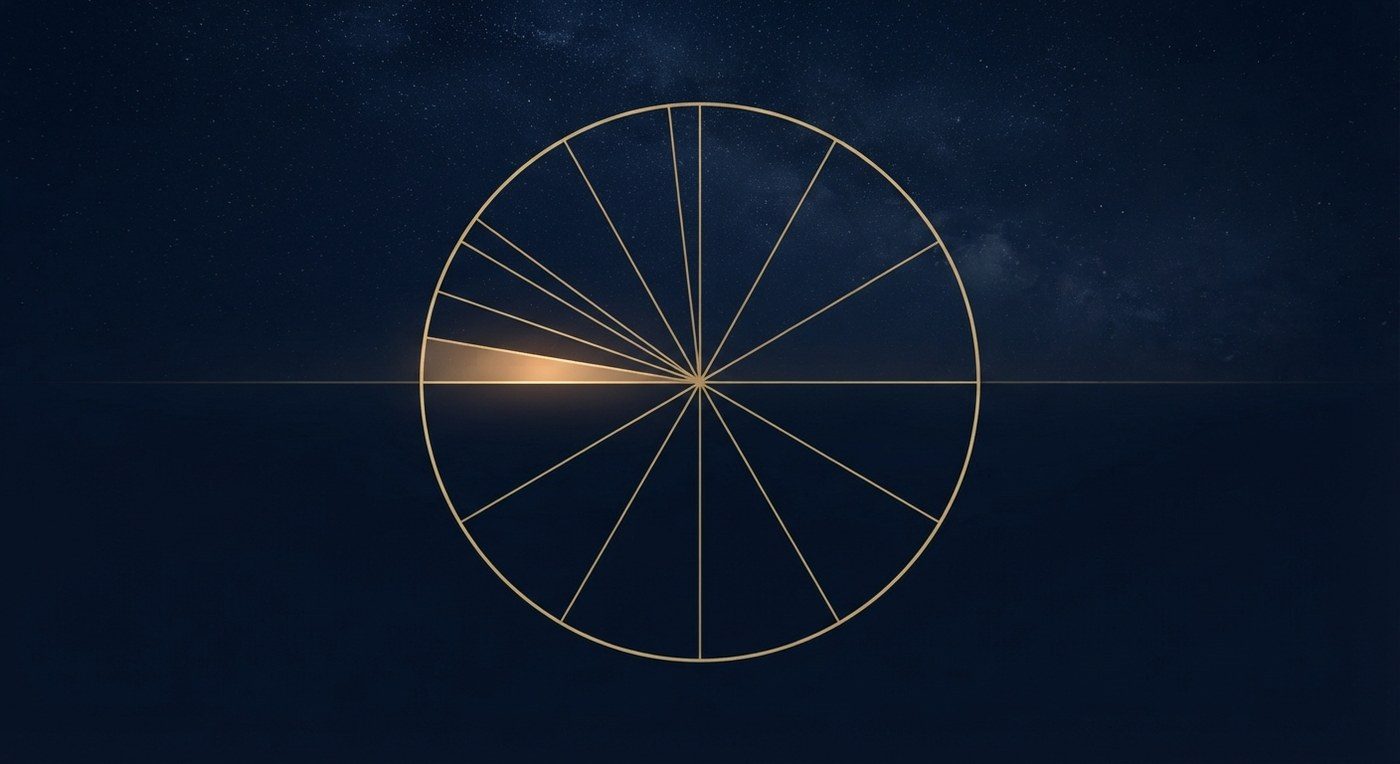
Here is the detail that surprises people. The twelve signs are equal, each one a clean thirty degree slice of the ecliptic. The twelve houses are usually not. Most house systems divide the sky by the way it actually rises over your horizon, and near the poles that produces houses of very different widths. A chart can show one house spanning forty degrees and the next only fifteen.
So a sign and a house are not the same size, and they do not line up neatly. A planet can sit in the last degrees of a sign and still fall in the next house, because the two grids are counted differently. This is the single most common source of confusion when someone reads their own chart for the first time.
What each house covers
Each house has a theme, and the themes run in a fixed order around the wheel. The first house is you as you appear, the body and the first impression. The second is what you own and earn. The third is daily communication, siblings and short trips. The fourth is home, family and roots. The fifth is play, creativity and romance. The sixth is work, routine and health habits.
The second half turns outward. The seventh is partnership and open rivals. The eighth is shared resources and deep change. The ninth is travel, study and belief. The tenth is career and public standing. The eleventh is friends, groups and hopes. The twelfth is rest, solitude and what stays hidden. Read in order, they trace a life from self to other to the wider world and back to quiet.
How signs and houses work together
A planet carries a sign and sits in a house, and the two answer different questions. The sign describes how the planet behaves, its style and mood. The house describes where that behaviour shows up, the area of life it touches. A Moon in a fire sign and a Moon in the fourth house are not in conflict. One says the feeling is quick and warm, the other says it plays out at home.
This is why a full reading needs more than a Sun sign. The zodiac sign calculator gives you the sign layer, and the moon sign calculator adds the emotional one. The houses are the third layer, and they only appear once a birth time and place are known.
Finding your own houses
You do not need to memorise the wheel to start. Begin with the rising sign, because it sets the first house and the rest follow in order. If your rising sign is Libra, the first house is Libra, the second is Scorpio, and so on around the twelve. That single fact lets you place every house in your chart by counting forward from the ascendant.
Then look at which house holds your Sun and which holds your Moon. Those two placements tell you where your core identity and your private feelings are anchored. The zodiac sign pages explain what each sign brings to a house, so you can read the pairing without a textbook.
Why the birth time matters so much
The houses move fast. The ascendant shifts about one degree every four minutes, so a birth time that is off by half an hour can push a planet into the neighbouring house. That is not a small error. It can move a planet from the tenth house of career into the ninth house of study, which changes the reading entirely.
If you do not know your exact time, the signs still work, because the Sun and often the Moon follow from the date alone. The houses are the part that waits. A birth certificate, a hospital record or a family note is worth more here than any guess. The how we calculate page explains how the horizon and the time zone are worked out, and why the same clock time in two cities is not the same instant.
A simple way to start
Pick one planet and follow it through both layers. Note its sign, then note its house. Say the two together in a sentence: the planet, its style, and the area of life it touches. Do that for the Sun, the Moon and the rising sign, and you have the backbone of a chart. The houses stop feeling abstract once a single planet has a home in one of them.
From there the wheel opens up. Every planet you add is another sign and another house, and the chart becomes a set of placements rather than a single label. That is the shift from reading a sign to reading a chart, and it starts with the twelve houses.