Opposite Zodiac Signs: The Six Pairs Explained
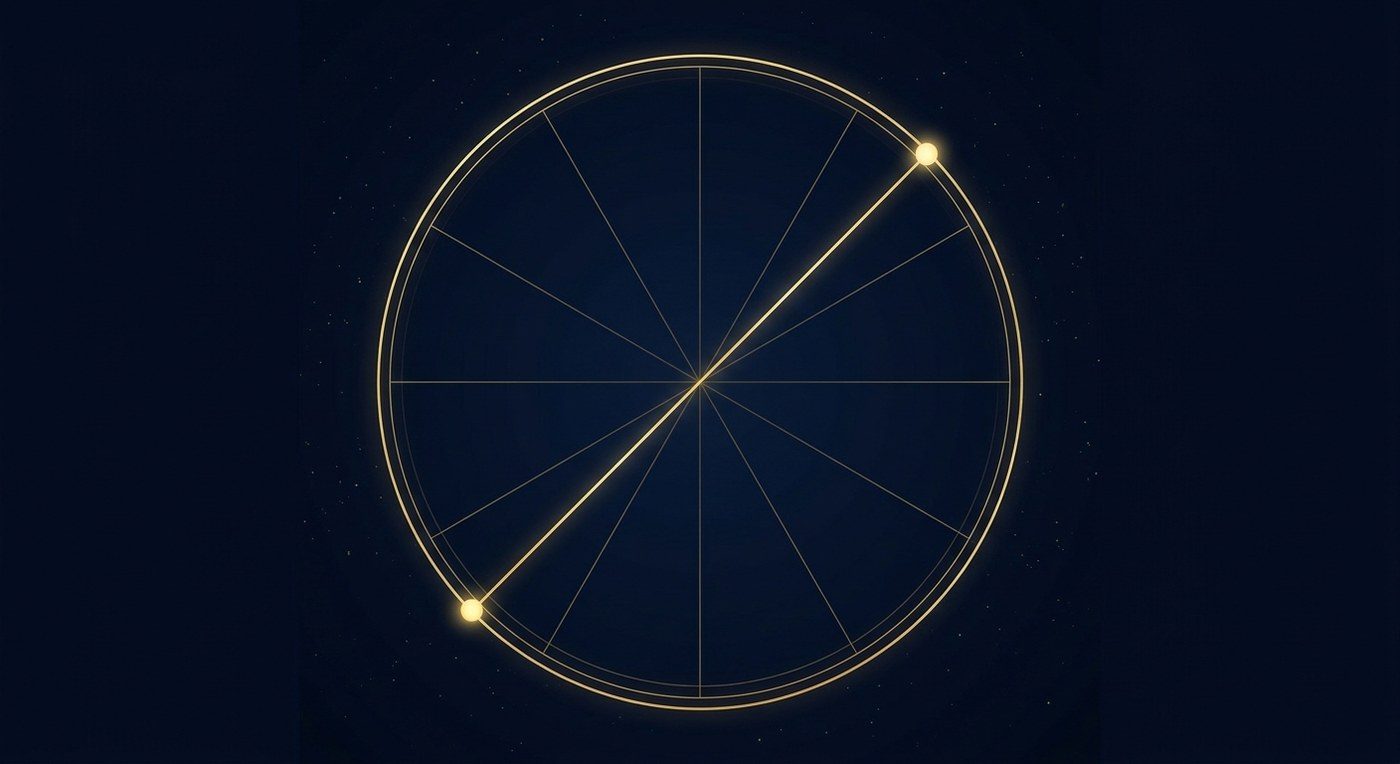
Every zodiac sign has a partner on the far side of the wheel. Aries pairs with Libra, Taurus with Scorpio, and so on around the twelve. These six pairs are called opposite signs, and the name makes them sound like rivals. They are not. Two signs 180 degrees apart share the same modality, sit in elements that work together, and tend to describe two ends of one question.
What an opposite sign actually is
Take the twelve signs in order and count six steps from any one of them. Aries is the first sign and Libra the seventh, so they face each other across the circle. Taurus faces Scorpio, Gemini faces Sagittarius, Cancer faces Capricorn, Leo faces Aquarius, and Virgo faces Pisces. Each pair is separated by half the circle, which is 180 degrees.
That geometry is the whole definition. There is no judgement in it and no ranking. The pairing is a fact about where the signs sit, and the meanings that follow come from that fact rather than from any claim that one sign completes or defeats the other.
Why opposites share a modality
Modalities repeat every four signs, because there are three of them and they cycle. Count six from a cardinal sign and you land on another cardinal sign. Aries and Libra are both cardinal. Taurus and Scorpio are both fixed. Gemini and Sagittarius are both mutable. Opposites always match on modality, which surprises people who expect opposites to differ in every way.
Modality describes how a sign starts a season, holds it, or hands it on. Two signs that share it approach change in the same manner. What differs is the subject they apply it to.
The element rule
Elements repeat every four signs as well, so opposites never share an element. They always land in the friendly pairing instead: fire with air, earth with water. Aries is fire and Libra is air. Taurus is earth and Scorpio is water. Gemini is air and Sagittarius is fire. Cancer is water and Capricorn is earth. Leo is fire and Aquarius is air. Virgo is earth and Pisces is water.
Fire and air feed each other, and earth and water hold each other. That is why opposite signs rarely read as pure contradiction. They read as one pair arguing about the same thing from two working angles.
The six pairs and the question each carries
Read each pair as a single question with two answers, not as two separate sets of traits.
- Aries and Libra: who moves first. Both are cardinal, so both start things. Aries starts from its own impulse, Libra starts from the balance of the room.
- Taurus and Scorpio: what to do with what you have. Both are fixed. Taurus keeps it, Scorpio transforms it.
- Gemini and Sagittarius: where meaning comes from. Both are mutable. Gemini gathers the detail, Sagittarius builds the larger frame.
- Cancer and Capricorn: what a life is built around. Both are cardinal. Cancer builds from care, Capricorn builds from structure.
- Leo and Aquarius: who the group serves. Both are fixed. Leo puts the self forward, Aquarius puts the collective forward.
- Virgo and Pisces: how to handle the details. Both are mutable. Virgo refines them, Pisces dissolves them.
Where people get opposites wrong
Two mistakes are common. The first is treating an opposite as an enemy sign, which turns a description of geometry into a personality test. Nothing in the calculation says two people with opposite Sun signs will clash. The second is treating opposite signs as identical once the modality match is spotted. Sharing a modality means sharing a method, not a conclusion.
Opposites are not a compatibility score
Popular writing often calls opposite signs incompatible, usually without showing any working. The pairing is a position on a wheel. What two people do with it depends on their charts, their temperaments, and their circumstances, and no single sign placement settles that. If you want a plain reason to compare two signs, use what each one measures rather than a rating.
Reading an opposite sign in your own chart
If your Sun sign is Aries, the opposite is Libra, and Libra themes are the ones you tend to notice in other people before you notice them in yourself. The same holds for the Moon and the rising sign.
The Moon sign is the placement people most often miss, because most days it needs a birth time. Run the Moon sign calculator if that one is still blank. If the Moon was in Virgo when you were born, Pisces is its opposite, and Pisces themes are the ones that show up in people you find either restful or puzzling.
The rising sign gives you a second axis. Two people with the same Sun sign but rising signs six apart are working the same question from opposite ends of the wheel, and their charts usually look less alike than the Sun signs suggest.
Checking the pairs with the calculators
Start with the zodiac sign calculator, which returns your Sun, Moon and rising signs in one pass and draws the wheel with the signs and the constellations behind them. Once you have those three, find each one's opposite by counting six places around that wheel. The twelve zodiac sign pages give you each sign's dates, element and ruling planet if you want to check the arithmetic.
If you know your Sun sign and want the horizon as well, the rising sign calculator works from the eastern horizon directly and asks for the birth time it needs. Both tools run in your browser, and the birth details you type stay on your device rather than being sent anywhere. The method page explains what each calculator requires and why a time matters for some signs and not others.
A short way to hold the idea
Opposite signs share a modality, sit in elements that support each other, and describe two ends of one question. That is enough to read most pairs correctly without memorising twelve separate definitions. When a pair looks contradictory, look for the question underneath. Aries and Libra disagree about who moves first, not about whether to move at all.