What a Stellium Is in a Birth Chart
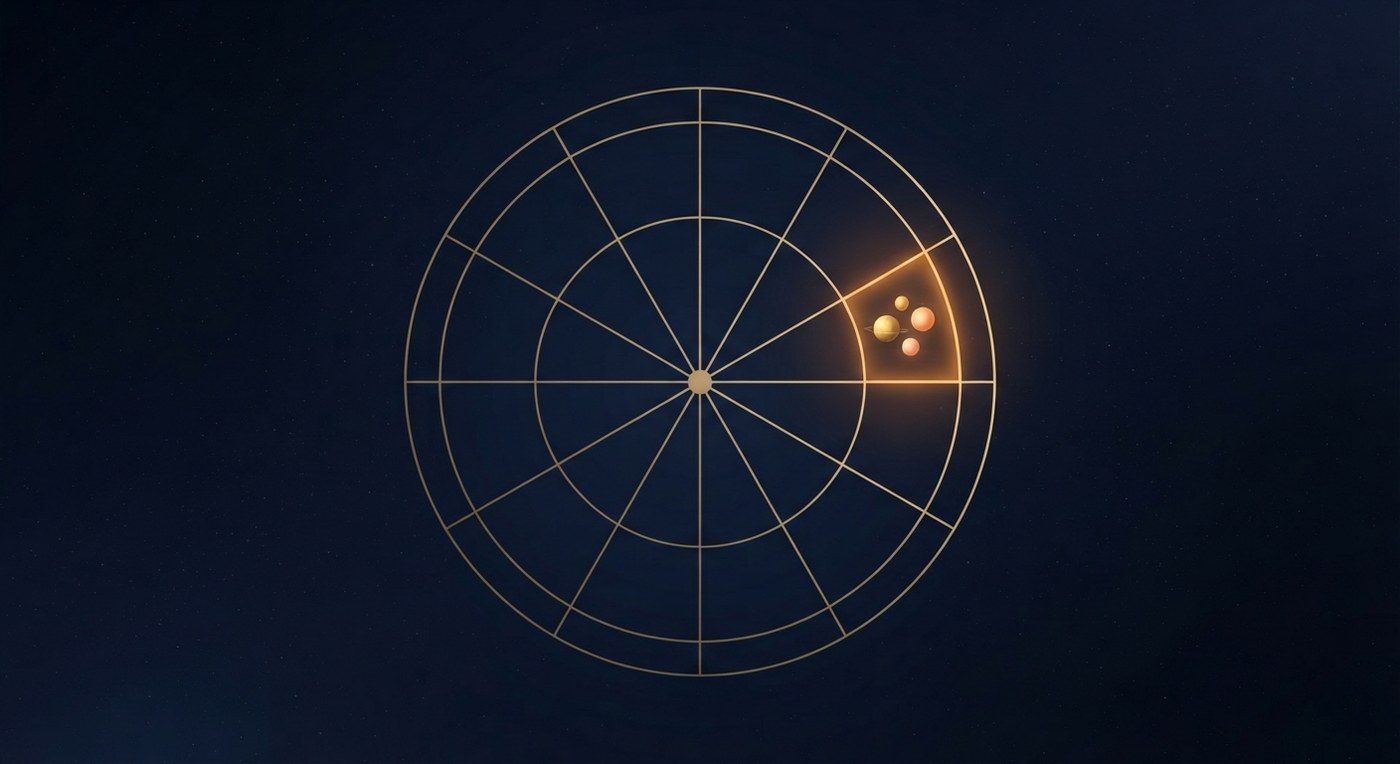
A stellium is what astrologers call a pile-up: three or more planets sitting in the same zodiac sign. It is one of the few patterns you can spot without a full chart, because each sign calculator hands you one planet at a time and you only have to notice when several of them land in the same place.
What a stellium is
A stellium is a group of three or more planets in a single sign. The word comes from the Latin for a cluster of stars, and the idea is the same. Instead of the planets spreading around the wheel, several of them crowd into one slice of thirty degrees. When that happens, the sign they share stops being one voice among many and becomes the loudest thing in the chart.
Astrologers do not agree on the exact count. Some require three planets, some four, and some count only the slower ones. The common working rule is three or more, and the personal planets are the ones that matter most, because they are the ones a reader can find without a full ephemeris.
Which planets count
Not every point on the wheel is a planet. The Sun and Moon are called luminaries, and many astrologers count them toward a stellium anyway, because they are the two placements most people already know. Mercury, Venus and Mars are the personal planets, and they move quickly enough to bunch up often. Jupiter and Saturn move slowly, so when they join a cluster it tends to last for months rather than days.
The outer planets, Uranus, Neptune and Pluto, move so slowly that they sit in the same sign as whole generations. A cluster made only of those is usually not called a stellium, because it says more about the era you were born in than about you.
How to find yours with the calculators
You do not need a chart wheel to check. Each CalcJournal calculator returns one planet's sign from your birth date, and the birth data stays in your browser. Run them one at a time and write down the sign each one gives you.
Start with the zodiac sign calculator for your Sun, then the moon sign calculator for your Moon. Add the mercury sign calculator and the venus sign calculator, and the mars sign calculator if you want the full set of personal planets. Lay the results side by side. If three or more share a sign, you have a stellium.
Because the calculators use the same wheel arithmetic, the signs line up exactly. The how we calculate page explains the counting, so you can see why two planets a few days apart can still land in the same sign.
Why a stellium reads so loudly
A sign with one planet in it is a single note. A sign with three is a chord, and the chart keeps returning to it. Astrologers read a stellium as a concentration of energy. The matters of that sign, and of the house it falls in, come up again and again, and the person tends to develop that part of life more than the rest.
The sign itself sets the flavour. A cluster in a fire sign reads as drive and self-expression, in an earth sign as building and keeping, in an air sign as thinking and talking, in a water sign as feeling and intuition. The zodiac sign pages list each sign with its element, so you can name the tone of your cluster in one step.
A stellium is not a stronger sign
It is tempting to read a stellium as a sign that has been turned up. That is only half right. Three planets in one sign do not make that sign more powerful in a general sense. They make it more specific. Each planet keeps its own job, so a cluster is really three or four separate statements that happen to share a setting.
That is why two people with a stellium in the same sign can read very differently. One may have the Sun, Mercury and Venus there, which points to identity, speech and taste. Another may have Mars, Saturn and Pluto, which points to drive, structure and pressure. Same sign, same crowd, different sentence.
What a stellium does not mean
A stellium is not a forecast, and it is not a verdict. It describes where the planets were at your birth, not what will happen to you. It is also not a measure of how good or difficult a chart is. A crowded sign is simply a crowded sign, and the reading depends on which planets are in it and what they are doing.
It also does not replace the rest of the chart. The other signs still hold placements, and the angles between them still matter. A stellium is one strong feature, not the whole picture.
Reading your cluster in one pass
Once you know you have a stellium, three questions do most of the work. Which sign is it in, which tells you the tone. Which planets are in it, which tells you the subjects. And which house it falls in, which tells you the area of life it keeps pointing at. The first two you can answer from the calculators alone. The third needs a birth time, because houses are counted from the rising sign.
Start with the sign and the planets. That is enough to say something real about a chart, and it takes only a few minutes with the tools you already have.