What an Empty House Means in a Birth Chart
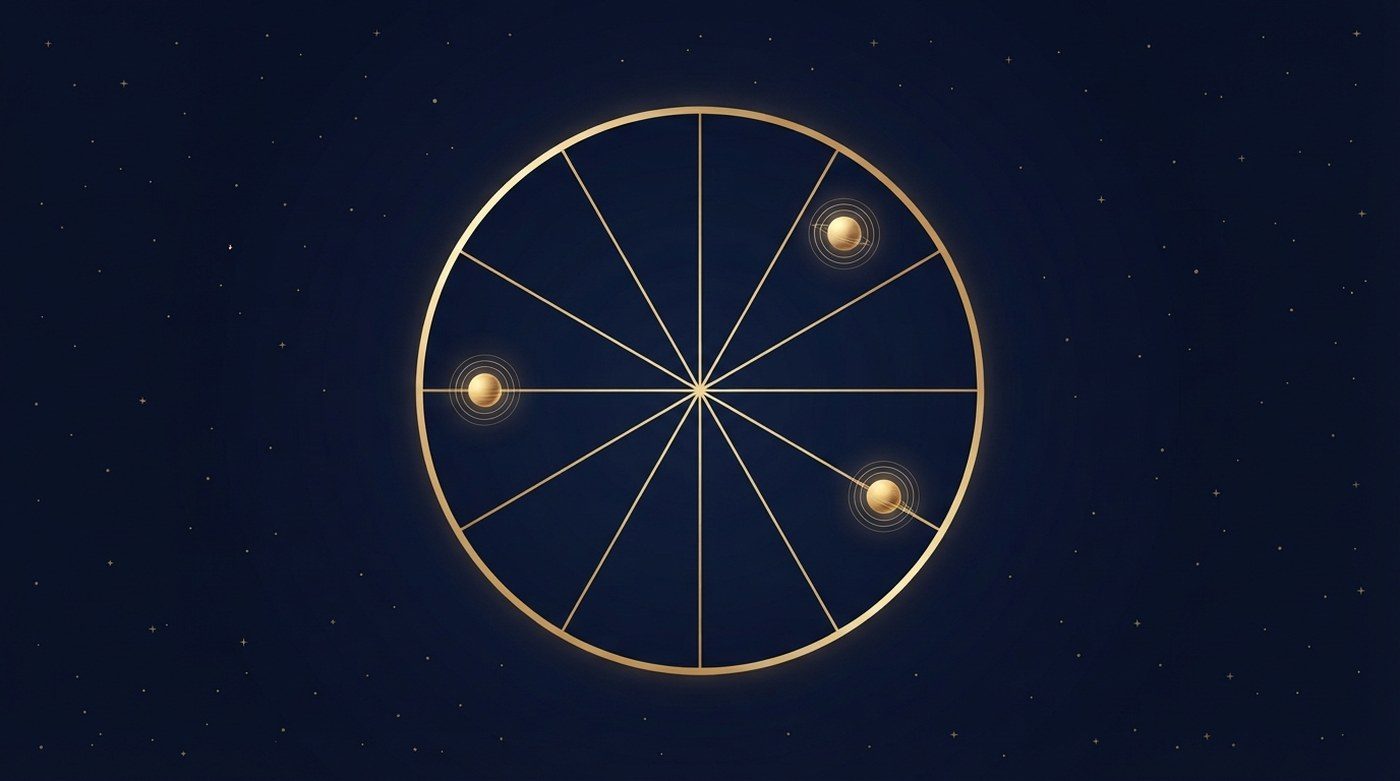
Open a birth chart and the first thing most people notice is where the planets sit. The second is all the empty space. Twelve houses, ten or fewer bodies, and nothing in half the wheel. It looks like missing information. It is not.
What an empty house is
An empty house is a house with no planet sitting in it. That is the entire definition. The house is still there, still counted from the same starting point, and none of them is switched off. A chart with seven empty houses is not a broken chart.
Most charts have more empty houses than full ones. The ten bodies usually counted, the Sun, the Moon, Mercury, Venus, Mars, Jupiter, Saturn, Uranus, Neptune and Pluto, have to be spread across twelve houses, and two or three often share one. Six or seven empty houses is ordinary.
Why the wheel is mostly bare
Two things cause it. The first is the count. Ten bodies cannot fill twelve houses, so at least two houses are always empty, and usually far more.
The second is clustering. Mercury never strays more than about 28 degrees from the Sun, so it is always in the same sign as the Sun or one sign away, and those two often land in the same house or in neighbouring ones. Jupiter spends about a year in a sign and Saturn about two and a half years, long enough that a whole generation carries the same placement. The result is a wheel where a handful of houses carry several bodies and the rest carry none.
Empty does not mean weak
This is where a lot of readings go wrong. An empty house is not a house with nothing to say, and it is not a part of life you lack. Every house describes an area of life, and you still have that area whether or not a planet sits inside it.
Think about what a planet in a house actually does. It puts emphasis there. It makes that subject loud, recurring, and easy to notice. Someone with three planets in the seventh house thinks about partnership constantly, because that part of the chart is crowded. Someone with nothing in the seventh still has relationships. They simply do not organise their life around them the same way. Read an empty house as a subject that runs in the background.
The ruler of an empty house
There is one technical answer, and it is the part worth learning. Every house has a sign sitting on its starting edge, called the cusp. That sign has a ruling planet, and the planet ruling the cusp of an empty house is the body that answers for it.
Say a house has its cusp in Taurus. Taurus is ruled by Venus. So even with nothing in that house, you look at where Venus sits: its house and its sign. That placement describes how the empty house gets handled.
Finding that ruler
You need two pieces of information. Which sign sits on the cusp, and which planet rules that sign. The sign on a cusp needs a birth time, because the cusps move with the clock. The twelve houses are laid out from the rising sign, and that is the point travelling fastest, changing about every two hours. Without a time the cusps cannot be placed.
The ruler itself is a lookup rather than a calculation. Every sign has one, and the zodiac sign index repeats it at the top of each sign page.
Reading an empty house in practice
Work backwards from the ruler. Take the fourth house, the one about home and roots. Suppose it is empty and its cusp falls in Capricorn. Capricorn is ruled by Saturn. Now look at Saturn: which house it occupies and which sign it is in. If Saturn sits in the tenth, the subject of home runs through work and public standing. A subject with no planet of its own is handled wherever its ruler is busy.
That is the difference between saying "my fourth house is empty" and saying "my fourth house is ruled by Saturn, which sits in my tenth". The first is a fact about the drawing. The second is something you can use.
What an empty house does not mean
It does not mean the subject is missing from your life, that you are bad at it, or that the house is cancelled. Planets keep moving after your birth. Transits, the current positions of the sky measured against your chart, pass through empty houses all the time. An empty house at birth is a fixed drawing, not a permanent absence of activity. Nor does it mean the area is unimportant.
Checking your own chart
Start with the house holding the most planets. That is the loudest subject in the drawing. Then take the house directly opposite, which is usually empty, and read its ruler. Those two together say more than either on its own. Then pick one empty house that matters to you now and follow its ruler: note the sign on the cusp, the ruling planet, then where that planet sits.
If you do not have a birth time, begin with the tools that only need a date. The Sun sign follows from the calendar day and the Moon sign usually does too, though it can change partway through a day. That gives you two placements while the houses wait.
Where the tools fit
The rising sign calculator places the starting point of the twelve houses, and the whole layout depends on that one point. The zodiac sign calculator returns the Sun, Moon and rising signs together, enough to see the shape of a chart before you go house by house.
The planet tools run the other way. The Venus sign calculator finds which sign Venus occupied at your birth, and the Mercury tool does the same for Mercury. Those placements matter when a house is empty, because a ruler sitting in a particular sign often explains the house it governs.
Every one of these runs in your browser. The date, city and time you type are used on your device, are not sent anywhere, and are not stored. The how we calculate page sets out what each tool needs.
A short way to remember it
A planet in a house is a spotlight. An empty house is a room with the light off, and its ruler is the switch, sitting somewhere else on the wheel. You need the cusp sign, the ruler of that sign, and the position of that ruler.