What the Descendant Means in a Birth Chart
Most people can name their Sun sign without thinking. Far fewer can name the sign that was setting on the western horizon at the moment they were born. That point is the descendant, one of the four corners of a birth chart, and the corner almost nobody looks up because the usual calculators stop at the Sun, the Moon and the planets.
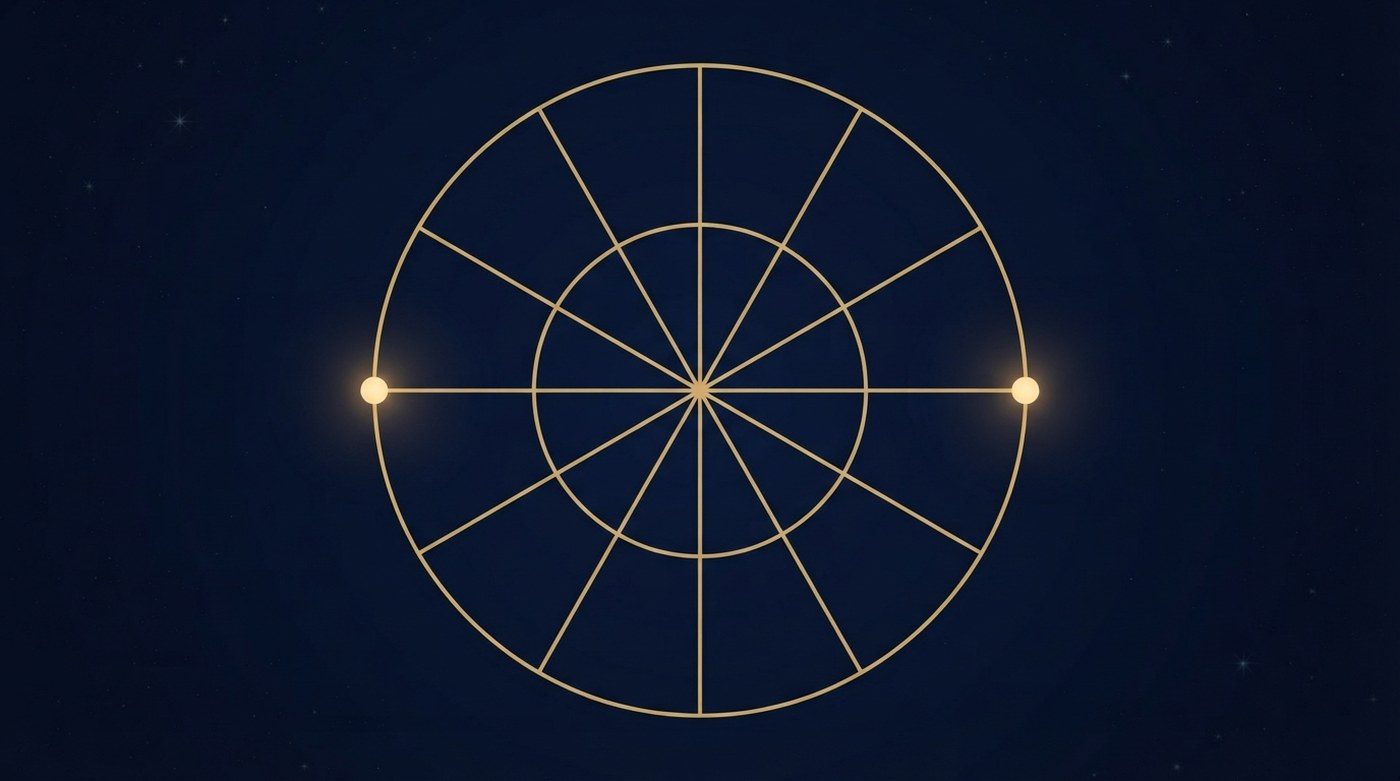
This guide explains what the descendant is, why it sits opposite your rising sign, and what the tradition says it describes. It is a reading of a position, not a forecast.
What the descendant is
A chart is drawn as a circle with the horizon laid across it as a straight line. The eastern end is the point coming up as you were born, your rising sign, also called the ascendant. The western end is the point going down. That is the descendant.
The two are not separate measurements. They are the two ends of a single line, so they are always exactly opposite each other on the wheel. If your rising sign is Aries, your descendant is Libra. If your rising sign is Virgo, your descendant is Pisces. No chart has the two disagree.
Older books write the descendant as DC, the same shorthand that gives the midheaven as MC. What matters is that it is a degree on the turning sky, not a planet and not a sign you can read from a birthday alone.
Why it is always opposite the rising sign
Because the horizon is a line, and a line has two ends. When the sky turns, one degree rises in the east as another sets in the west. Those two degrees are one hundred and eighty degrees apart, which is exactly six signs.
The two ends of one line
This is why the pairs feel like a matched set in the older literature. Aries rising is paired with Libra on the descendant, read as a chart that meets the world through partnership rather than a solo start. Taurus rising is paired with Scorpio, and the note becomes steadiness meeting intensity. The pairing falls out of the geometry.
It also means you cannot change one without the other. If a birth time correction moves your rising sign back one sign, your descendant moves back one sign too.
Why the descendant needs a birth time
The descendant is a point on the local horizon, so it depends on the clock and the place. The sky turns once a day, so the whole wheel of horizon points sweeps past in about twenty four hours. A single sign sits on the eastern horizon for roughly two hours, and the same is true on the western side.
That is the practical consequence. A birth time off by an hour can move the descendant by half a sign, and off by three hours by a sign and a half. A wrong birth city shifts the horizon too, because the same clock reading in two cities is not the same instant. The rising sign calculator asks for a date, a city and a time for this reason, and reports the descendant as the opposite point of the result.
If you only know your birthday, you can still get a Sun sign from the zodiac sign calculator. You cannot get a descendant, because it changes every couple of hours.
What the descendant describes
The tradition treats the rising sign as the first impression, the face you present. The descendant is read as the other side of that meeting: what you look for in a partner, and how you behave once someone is close enough to be one.
That is a description of a style, not a promise about who will appear in your life. A Libra descendant is not a guarantee of a Libra partner, only a note about the qualities you notice and negotiate with.
The seventh house connection
In most house systems the descendant is also the start of the seventh house, the slice given to partnership and open rivals. That is why the two are taught together. The seventh house covers one-to-one relationships of all kinds, from a spouse to a business partner to the person across the table in a disagreement.
The zodiac sign pages describe each sign on its own terms, and the descendant is where one of those descriptions attaches to the partnership end of a chart.
How to find your descendant sign
Three steps, and the first two are the ones people skip.
- Get your birth date, birth city and birth time as close to the record as you can. A birth certificate beats a family estimate.
- Run the rising sign calculator with all three. The result gives the ascendant degree and sign.
- Count six signs forward from the rising sign. That is the descendant. Aries gives Libra, Taurus gives Scorpio, Gemini gives Sagittarius, and so on around the wheel.
If the calculator reports a rising sign at the very end of a sign, treat the descendant as approximate. A few minutes of clock error can push the ascendant into the next sign, and the descendant moves with it. The how we calculate page explains the library and its accuracy.
Reading the descendant without overclaiming
The descendant is one point among several, and the one most sensitive to bad input. Two habits keep a reading grounded.
First, check the birth time before you trust the sign. If the time is a guess, read the descendant as a range rather than a fixed answer. Second, read it next to the rest of the chart. A descendant with no planets near it is a quiet note. One with a planet on it is louder, and the planet usually gets the first mention.
It also helps to keep the descendant separate from the Moon. The moon sign calculator answers a different question about what someone needs in private, and the two are often confused because both are described in emotional language. The Moon is a body. The descendant is a point on the horizon.
Where the descendant fits
The four corners of a chart are the rising sign, the descendant, the midheaven and the point opposite it. Each is a degree rather than a planet, and each needs a time and a place. The descendant is the corner that describes the meeting.
If you have your birth time, you already have the answer. Count six signs from your rising sign, then read that sign as the partnership end of the chart. If you do not have a time, leave the descendant blank rather than guess it.