What the Imum Coeli Means in a Birth Chart
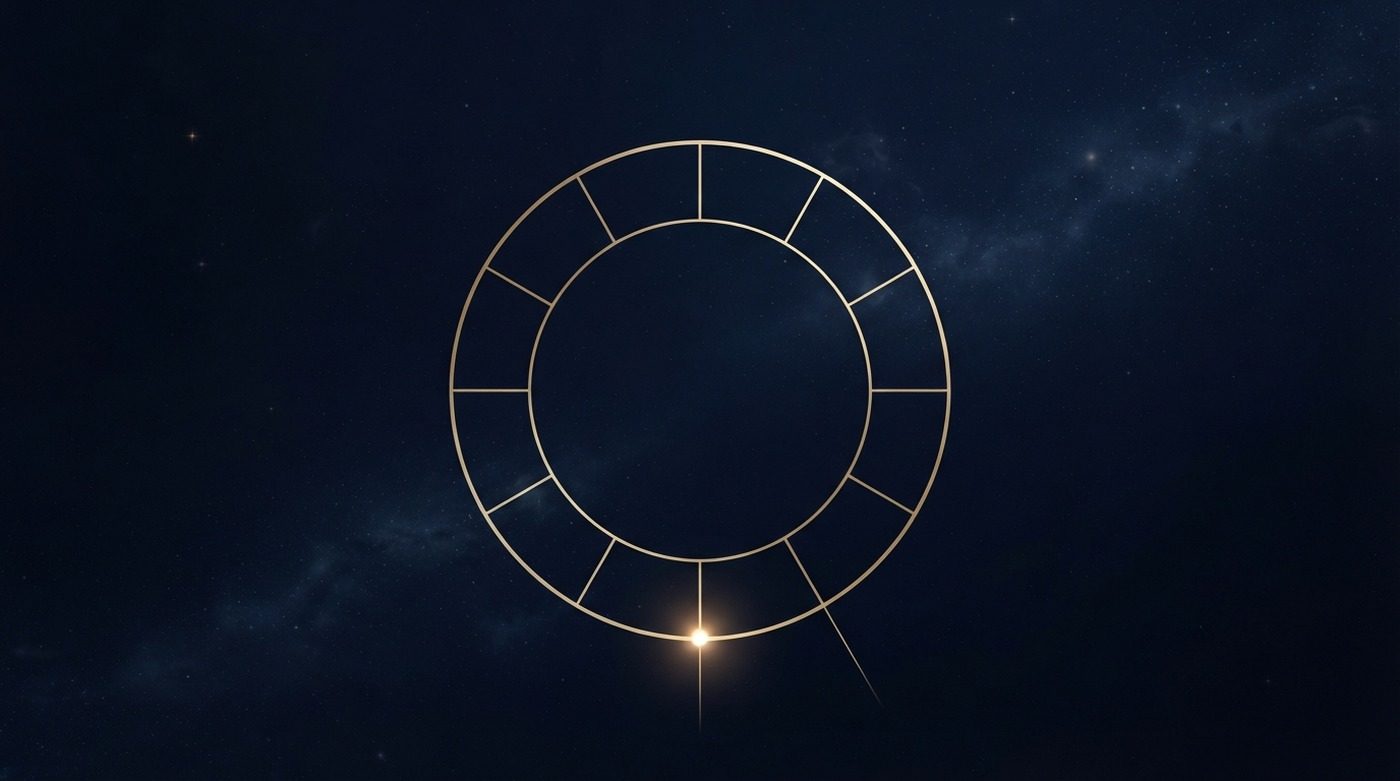
Most chart reading stops at the planets and, if you are lucky, at the rising sign. The wheel actually has four corners. Two get named often, the rising sign and the midheaven, and the other two are usually left blank. One of those is the imum coeli, the point at the very bottom of the chart, and it answers a question the planets do not: where you come from, and what you go back to.
What the imum coeli is
Imum coeli is Latin for the bottom of the sky. It is written IC on a chart, and it is a single degree of the zodiac, not a planet and not a house full of objects. Draw a line from the top of the wheel to the bottom: the top end is the midheaven, the point overhead at your birth, and the bottom end is the imum coeli, the point under the earth, directly below your feet and out of sight.
Because it is a point rather than a body, nothing sits on it unless a planet happens to be there, so it is easy to miss. The IC is only a degree and a line where the fourth house begins.
In most house systems the IC is the cusp of the fourth house. So the sign on that degree colours the fourth house, and the fourth house is where a reading turns personal: home, family, the place you return to, the private version of you that performs for nobody.
Why it needs a birth time and a city
The IC is set by the turning of the sky, not by the calendar. The sky turns once in about 24 hours, so the bottom of the meridian sweeps through all twelve signs in a day, roughly one sign every two hours. A birth time that is off by an hour can move the IC by half a sign. A time rounded to the nearest hour is a range, not a fact.
The city matters as much as the clock. The meridian is a line drawn for one place on the earth. Two people born at the same moment in Karachi and in Sydney do not share a bottom of the sky, because the sky above each of them is different.
The rising sign needs both facts too, and the two move together. A real birth time and city give a real IC. A date alone does not, and guessing will not produce one.
The line from top to bottom
The midheaven and the imum coeli are opposite each other, exactly 180 degrees apart. If your midheaven lands near Gemini, your imum coeli sits near Sagittarius. They are two ends of one axis, which is why astrologers talk about them as a pair: the public direction at one end and the private base at the other.
What the IC describes
Traditionally the fourth house and its cusp describe the root of a life: the household you grew up in, the one you build, the ground under your feet, and the way you behave once the door is closed. Read the IC as the tone of that root.
A fire sign on the IC reads as a home that is active and loud, or a private life run on momentum. An earth sign reads as a need for physical steadiness, a fixed address, things that stay put. An air sign reads as a home full of talk and traffic. A water sign reads as a home that holds feeling, for better and for worse. Those describe a style, not a verdict on your family. The zodiac sign pages give each sign its element and modality, which is the quickest way to name a tone.
A planet sitting on the IC
Any planet within a few degrees of the IC is read as part of it, and it usually becomes one of the loudest placements in the chart, even though it sits at the bottom where nothing is visible. A planet there describes something that runs underneath the public life rather than on top of it.
The rule is the same as at the midheaven: the point gives the setting and the planet gives the subject. The IC alone says where the story happens. The planet says what it is about.
How to find yours
You need three inputs: the date, the clock time, and the birth city. The rising sign calculator asks for all three, because the rising sign is the eastern horizon and the IC is the bottom of the meridian, and both come from the same calculation. Whatever it returns for the horizon includes the fourth house cusp.
If you only want the broad picture, start with the sun sign from the zodiac sign calculator and the moon sign from the moon sign calculator. Neither needs a time, and together they describe more than a birthday usually gets credit for. Add the IC once you have a time you trust.
Every one of these tools runs in your browser. The date, city and time you type are used on your device, are not sent to CalcJournal, and are not stored. The how we calculate page sets out what each tool needs and why the city matters more than the formula.
What it does not tell you
The IC is not a childhood reading and it is not a diagnosis. It does not say what your family was like, and it does not predict where you will live. Two people with the same sign on the IC can have different homes, because the sign describes a manner, not an address.
It also does not stand alone. The ruler of the sign on the IC, the planets in the fourth house, and any planet sitting on the degree all change the reading. A single sign is a starting sentence, not the paragraph.
And it is not the moon sign. The moon sign describes what you need to feel settled. The IC describes the setting where that settling happens, and the two can disagree, which is often the interesting part.
Reading it in order
Start with the sign on the IC, which gives the tone of your base. Then note any planet sitting on that degree, which gives the subject. Then find the ruler of that sign and see where it sits.
Three steps, and you have a reading that belongs to your chart rather than your birthday. That is the value of the corners. They cost a birth time to reach, and they say something the sun sign cannot.