What the Midheaven Means in a Birth Chart
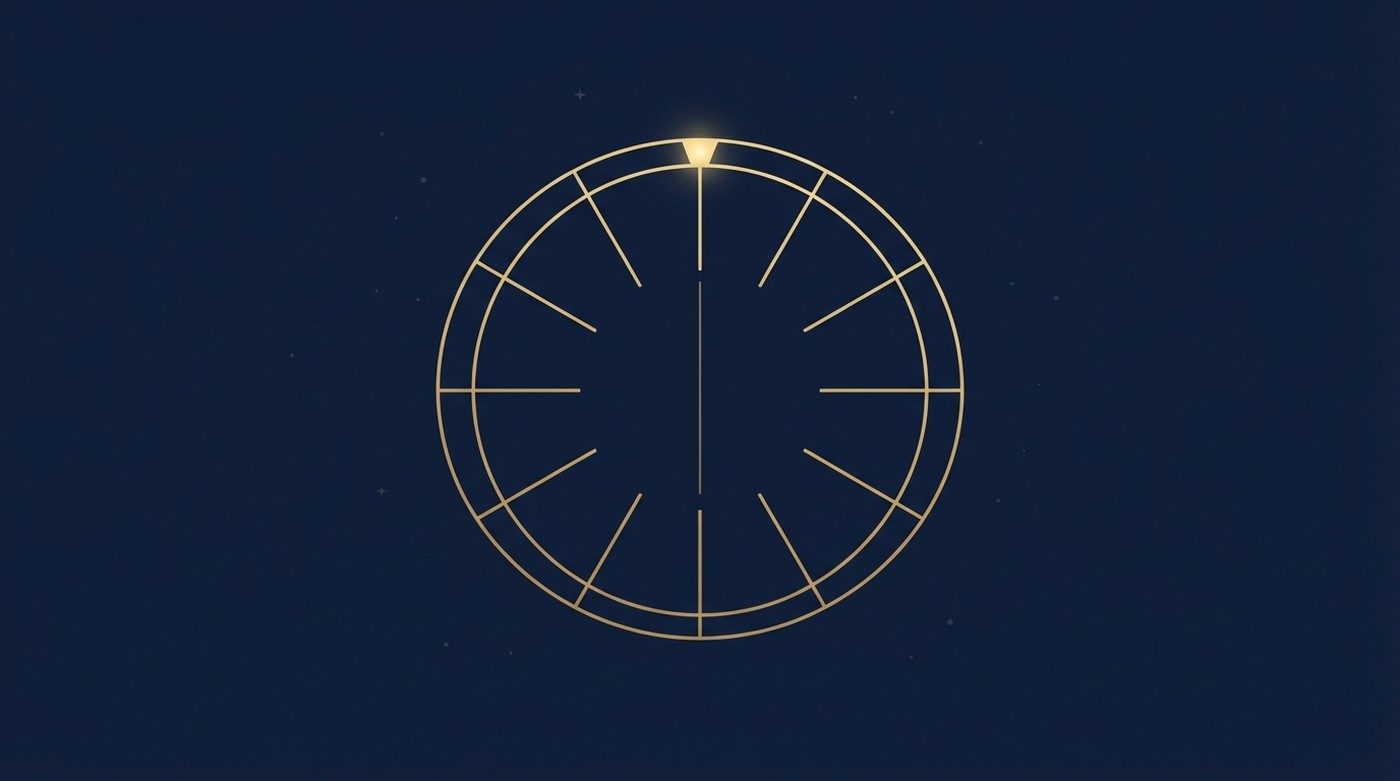
The midheaven is the highest point of a birth chart, the degree of the zodiac that was directly overhead at the place and minute you were born. It is usually written MC, short for medium coeli, Latin for the middle of the sky. Most people never look it up, because the sign calculators stop at the Sun, Moon and planets. It is still one of the four corners of a chart, and it answers a question the other placements do not.
What the midheaven is
A chart is drawn as a circle with the horizon laid across it. The eastern end of that line is the rising sign, the point coming up. The western end is the descendant, the point going down. The line drawn from the top of the circle to the bottom is the meridian, and its upper end is the midheaven.
Because it is a point on the turning sky rather than a planet, the midheaven is not something you can look up from a date alone. It is a degree, and a degree needs a moment and a place. That is the whole reason it stays out of reach for most people who only know their birthday.
The midheaven is also the start of the tenth house in most house systems. So when a book says the tenth house is career, the midheaven is the door into that house, and the sign sitting on it colours the whole section.
Why it needs a birth time and a city
The sky turns a full circle in about 24 hours, so the meridian sweeps through all twelve signs in a day. That works out to roughly two hours per sign, the same pace as the rising sign, though not exactly, because the sky does not turn evenly against the zodiac.
The city matters for the same reason it matters for the rising sign. The meridian is a line drawn for one longitude. Two people born at the same clock time in Karachi and in Toronto are not under the same overhead point, so their midheavens differ.
The difference from the rising sign
The rising sign and the midheaven are both set by the same two facts, the time and the place, and they move together. They are not the same point, though. The rising sign is the eastern horizon, the edge of the chart where things arrive. The midheaven is the top, the highest point of the arc. In a chart drawn with equal houses they sit about ninety degrees apart, which is three signs. If your rising sign is Virgo, your midheaven is usually near Gemini or Cancer, not Virgo.
That gap is why the two are read differently. The rising sign is the first impression, the way you arrive. The midheaven is the direction, the thing you are aiming at in public.
What the midheaven describes
Traditionally the midheaven is read as the public side of life: the work you are known for, the reputation you build, the role you take in the world outside your own door. It is not a job title and it is not a prediction. It is a description of the setting where your effort becomes visible.
The sign on the midheaven gives the manner of that visibility. A midheaven in a fire sign reads as a public style that is direct and visible. An earth sign reads as steady and cumulative. An air sign reads as communicative and social. A water sign reads as responsive and hard to pin down from outside. The zodiac sign pages list each sign with its element, so you can name the tone in one step.
Any planet sitting close to the midheaven is read as part of it. A planet within a few degrees of that point is said to be on the midheaven, and it tends to be one of the loudest placements in the chart, because it sits at the top where everything is visible.
How to find yours
You need three things: the date, the clock time, and the birth city. The rising sign calculator asks for all three, and the same inputs give the midheaven, because both come from the same horizon and meridian calculation. Everything you type stays in your browser and is not sent anywhere.
If you do not have a birth time, you cannot get a real midheaven. A chart drawn from a date alone has signs but no corners, and the midheaven is a corner. In that case work with the Sun sign from the zodiac sign calculator and the Moon from the moon sign calculator, and treat the midheaven as unknown rather than guessed.
If your time is rounded to the hour, treat the answer as a range. An hour of error can move the midheaven by more than a sign near the changeover. The how we calculate page explains how the horizon and meridian are computed, so you can see why the clock matters more than the formula.
What it does not tell you
The midheaven is not a career test and it is not a forecast. It does not say what you will do for a living, and it does not rank charts. Two people with the same midheaven sign can work in completely different fields, because the sign describes a manner, not a job.
It also does not stand alone. The ruler of the sign on the midheaven, the planets in the tenth house, and the aspects to that point all change the reading. A single sign is a starting sentence, not the paragraph.
Reading it in order
Start with the sign on the midheaven, which gives the tone of your public style. Then note any planet sitting on that point, which gives the subject. Then look at the ruler of that sign and where it sits, which gives the setting. Three steps, and you have a reading that is specific to your chart rather than to your birthday.
That is the practical value of a corner point. It takes a birth time to reach, and it says something the Sun sign cannot.