Zodiac Aspects: How the Angles Between Signs Work
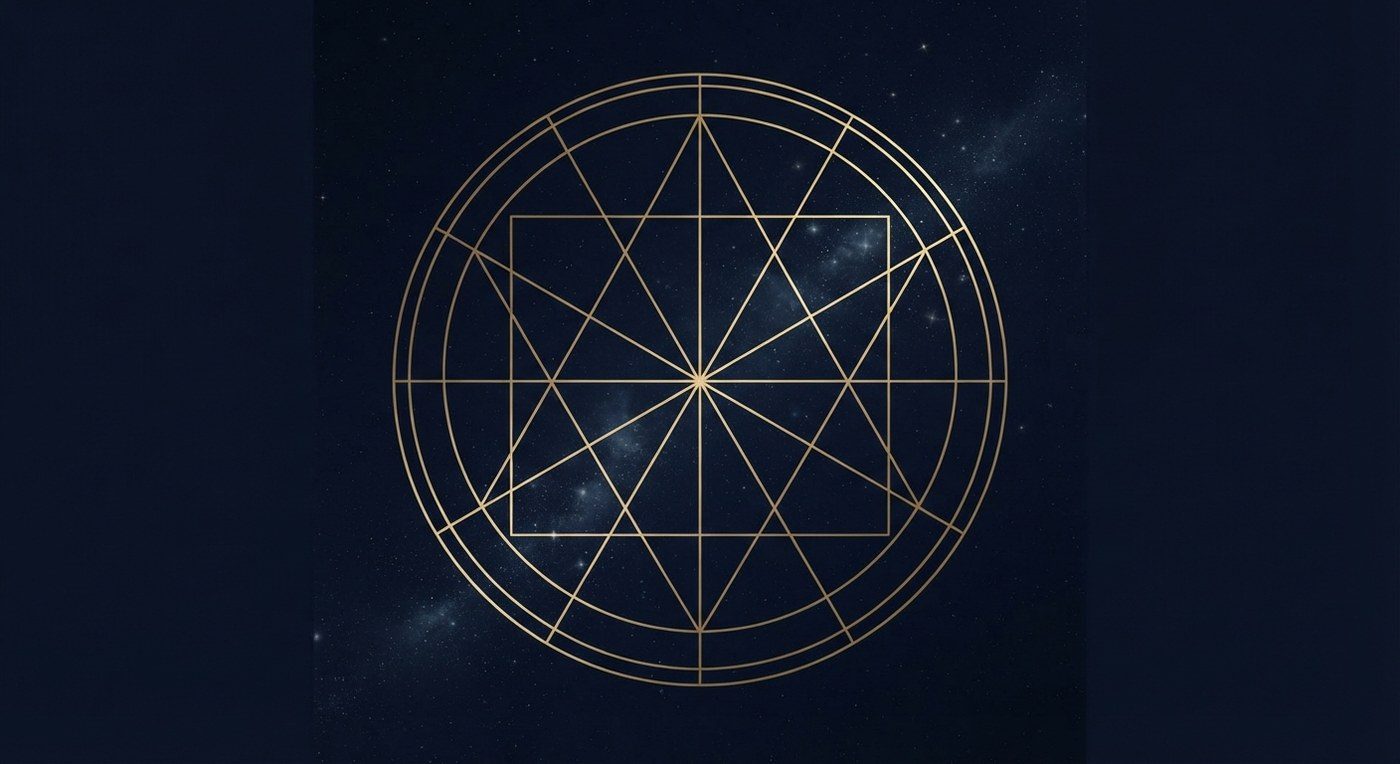
Two signs on the zodiac wheel are never just neighbours or strangers. They sit at a fixed angle to each other, and that angle is what astrologers call an aspect. Once you can read the angle, you can say something about how any two points in a chart relate before you look up a single meaning.
What an aspect is
The zodiac is a circle of 360 degrees, cut into twelve equal slices of 30 degrees each. Count from any sign and you can measure how far it is to any other. When that distance lands on one of a few special numbers, the two signs are said to be in aspect. The number is the whole point: it describes a relationship, not a personality. A sign on its own is a description. An aspect is a sentence with two subjects and a verb.
The geometry is the same one the calculators use. Every position is measured against the same wheel, counted from the March equinox, which the how we calculate page sets out in full. Aspects do not change that arithmetic. They are a second reading of the same twelve slices.
The five main angles
Astrologers use many angles, but five do most of the work. Each has a name, a number, and a mood.
Conjunction, 0 degrees
Two points in the same sign, or close to it, are conjunct. This is the tightest relationship on the wheel. The two are not looking at each other from a distance; they are standing in the same place, and their meanings blend. A conjunction is often read as a fusion, for better or worse, because neither point can act without the other.
Sextile, 60 degrees
Two signs apart. A sextile is an easy angle. The two points are friendly and can cooperate, but the link is gentle rather than automatic, so it tends to need a small nudge to show up. Signs of compatible elements often fall here.
Square, 90 degrees
Three signs apart. A square is a right angle, and it reads as friction. The two points want different things and pull against each other. That tension is not a flaw. It is the angle that forces a decision, which is why squares are usually described as the most productive difficult aspect.
Trine, 120 degrees
Four signs apart. A trine is the smoothest angle on the wheel. The two points share an element, so they already speak the same language, and the flow between them is easy. The risk of a trine is that ease can turn into laziness, because nothing is pushing.
Opposition, 180 degrees
Six signs apart, directly across the wheel. An opposition is a face to face angle. The two points are as far apart as the circle allows, and each tends to see the other as its opposite. Read well, an opposition is a balance to be struck rather than a fight to be won. The six pairs that sit at this angle are covered in their own guide to opposite zodiac signs.
Why the same angles keep returning
Because the wheel is built from repeating steps, the same angles show up again and again. Every sign has one sign opposite it, two signs at a sextile, two at a square, and two at a trine. That is why a single sign is never read alone. It arrives with a small set of partners already fixed by its place on the circle.
The elements and modalities make this easier to see. Signs of the same element sit at a trine, which is why they are said to understand each other on sight. Signs of the same modality sit at a square, which is why they often clash even when they share a goal. The zodiac sign pages list each sign with its element and modality, so you can trace the angles yourself.
Aspects between signs, not only planets
Most aspect talk is about planets, because a chart is a set of planet positions and the angles between them are what an astrologer reads. But the same numbers describe the signs those planets occupy. If your Sun is in one sign and your Moon is in the sign three steps away, the two are in square by sign, whatever the exact degrees. That sign level view is a quick way to see the shape of a chart before you go into detail.
This is where the calculators help. The zodiac sign calculator gives your Sun sign, the moon sign calculator gives your Moon, and the rising sign calculator gives your ascendant. Put the three side by side and you can count the steps between them. Two steps is a sextile, three is a square, four is a trine, six is an opposition. You do not need a full chart to see the main angles in your own placements.
How to read an aspect without overreading it
An aspect is a relationship, and a relationship needs both ends to mean anything. A square between two points says the two are in tension, not that either is bad. A trine says the two cooperate, not that the result is good. The angle sets the tone; the two signs set the content. Read them together and the sentence writes itself.
It also helps to remember that aspects are about distance, not closeness in feeling. Two signs at a trine are far apart on the wheel and still flow easily. Two signs at a conjunction are in the same place and can still crowd each other. The number tells you the geometry, and the geometry is what the word aspect actually means.
What aspects do not tell you
An aspect is not a forecast. It describes how two points relate, not what will happen on a given day. It is also not a measure of how strong a placement is; that depends on the exact degrees, which need a full chart. And it is not a verdict on a person. The same square appears in every chart that has those two signs in those positions, and it plays out differently in each life.
Treat the angles as a map of the wheel, not a set of predictions. Learn the five numbers, notice which ones your own signs fall into, and the zodiac stops being a list of twelve separate words and becomes a shape you can actually read.