Zodiac Decans: What Each Ten Degree Slice Means
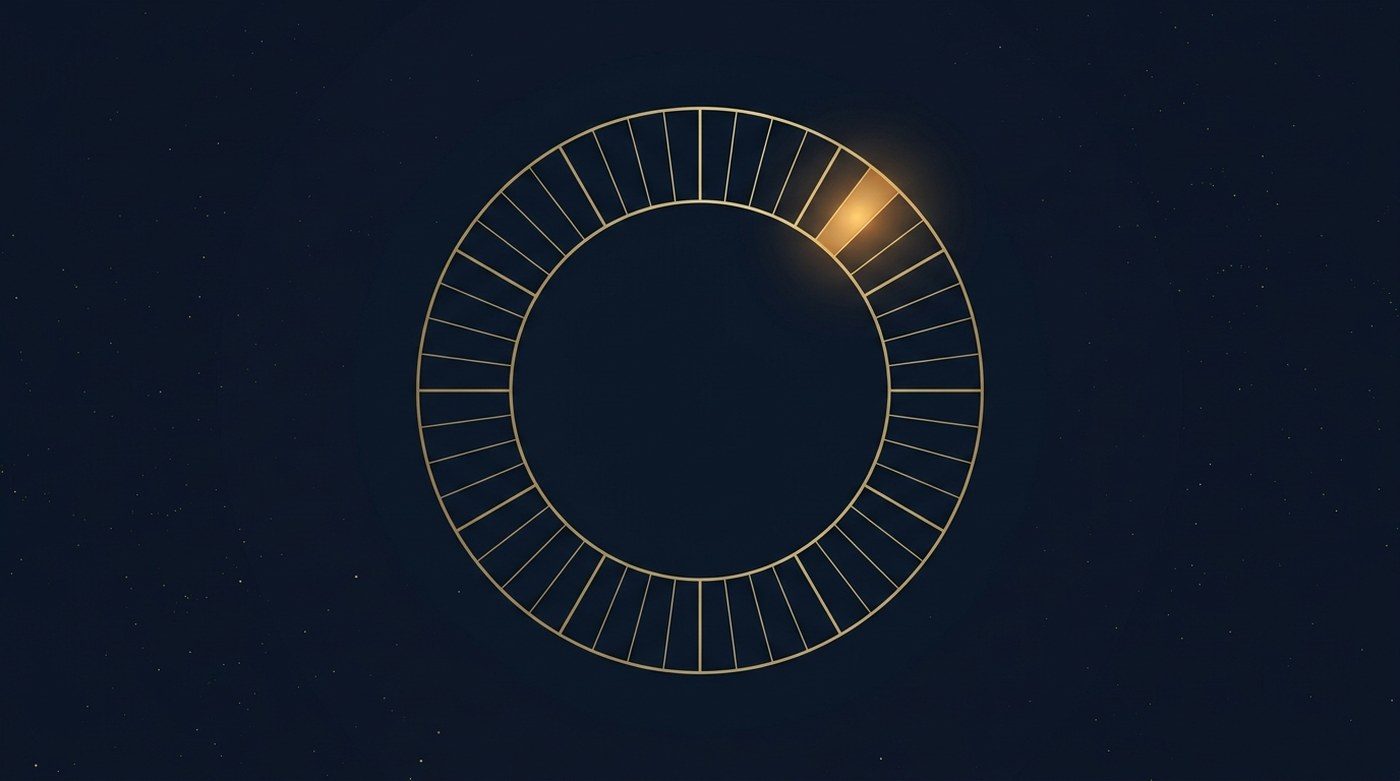
Most people know the sign the Sun stood in on their birth day. Fewer know a sign is thirty degrees wide, and that where you sit inside those thirty degrees matters. Divide each sign into three equal parts and you get the decans, thirty six ten degree slices all the way around the zodiac. The slice your Sun falls in gives you a second label that sits underneath your sign rather than replacing it.
What a decan actually is
The word comes from the Greek deka, meaning ten. Each sign covers thirty degrees, so it splits cleanly into three decans of ten degrees each. The first runs from 0 to just under 10 degrees of the sign, the second from 10 to just under 20, the third from 20 to 29. Astrologers write it as the sign plus a number, so Virgo in its second decan is Virgo 2.
A decan is not a thirteenth sign and not a second zodiac. It is a subdivision, the way a month divides into weeks.
Why a sign description can feel too broad
Someone born on 24 August and someone born on 20 September both answer Virgo, yet they are twenty seven degrees apart, nearly a whole sign. Any short description of Virgo has to stretch across both, which is why sign write ups often sound vague. The decan narrows the frame. Two Virgos in different decans share a sign but not the same emphasis, because a different planet sits alongside the ruler.
The rule that gives each decan a ruler
The most widely used system assigns decan rulers by triplicity, meaning by element. Signs of the same element form a group of three, and the rulers of that group cycle through the decans. The first decan is ruled by the ruler of the sign itself, the second by the ruler of the next sign of that element, the third by the ruler of the remaining one.
Aries shows it clearly. Aries is fire, and the fire group is Aries, Leo and Sagittarius. The first decan takes the ruler of Aries, which is Mars. The second takes the ruler of Leo, the Sun. The third takes the ruler of Sagittarius, Jupiter. Taurus, an earth sign, runs Venus, then Mercury from Virgo, then Saturn from Capricorn.
One note on names. The tables on this site give Aquarius, Pisces and Scorpio the modern rulers Uranus, Neptune and Pluto, so the lists below use those. Classical rulers would substitute Saturn, Jupiter and Mars, with the same pattern underneath.
The thirty six decans, sign by sign
Read each line as first decan, second decan, third decan.
- Aries: Mars, Sun, Jupiter
- Taurus: Venus, Mercury, Saturn
- Gemini: Mercury, Venus, Uranus
- Cancer: Moon, Pluto, Neptune
- Leo: Sun, Jupiter, Mars
- Virgo: Mercury, Saturn, Venus
- Libra: Venus, Uranus, Mercury
- Scorpio: Pluto, Neptune, Moon
- Sagittarius: Jupiter, Mars, Sun
- Capricorn: Saturn, Venus, Mercury
- Aquarius: Uranus, Mercury, Venus
- Pisces: Neptune, Moon, Pluto
Leo opens with the Sun and closes with Mars, picking up where Cancer stopped. The table is one repeating loop, a useful check on any decan list.
Finding your own decan from a birth date
The Sun moves roughly one degree a day, so the day count into your sign estimates the degree. Born on the third day of a sign, you sit near 3 degrees, in the first decan. Born on the twenty fifth, near 25, in the third. The word roughly is doing real work, because the Sun does not move at constant speed and a sign start drifts by hours from year to year.
The zodiac sign calculator handles the drift. It returns the sign from your birth date and, on a changeover day, uses the year and the clock to decide which side of the boundary you fall on. If you were born near the first or last day of a range, treat the day count as unreliable and check instead.
If you know the date but not the time
You can still place your Sun in a decan, because the Sun changes sign about once a month. You cannot do the same for the Moon, which crosses a whole sign in about two and a half days, so the Moon sign calculator needs a time on most birth days. The rising sign turns over roughly every two hours and always needs a time and a city.
Decans for planets other than the Sun
The same ten degree slices apply to any body in the chart. A Venus at 27 degrees of a sign sits in that sign's third decan and takes its ruler as a modifier. Because Venus spends a few weeks in a sign, the Venus sign calculator may ask for a time when Venus changes sign on your birth day. Mercury, Mars and the Moon work the same way once you know the degree.
Why two astrologers may name different decan rulers
A second system, older in some traditions, ignores the element groups and runs the planets in a fixed sequence around the wheel: Saturn, Jupiter, Mars, Sun, Venus, Mercury, Moon, repeating. It gives a different ruler for most decans, and a more regular pattern, since each sign's first decan continues where the previous sign stopped. Tarot decks are built on it.
Neither list is a mistake. The triplicity method groups decans by temperament, so the three fire signs share a family of rulers. The continuous method treats the zodiac as one unbroken chain. If two tables disagree, check which system each uses.
What a decan does not change
Your Sun sign stays your Sun sign. A decan is a modifier, not a promotion: it never moves you into the next sign or hands you a different element. It also does not touch your rising sign, a separate measurement based on the eastern horizon at your birth. The site's method page sets the convention: a sign here is a thirty degree slice of the ecliptic counted from the March equinox, not the constellation of the same name. A decan is ten degrees of that slice.
A simple way to use it
Read your sign first, then your decan ruler as an accent. An Aries in the first decan leans on Mars twice, which usually reads as more direct and impatient. An Aries in the third carries Jupiter as well, which tends to read as bigger and less interested in the fight itself. Same sign, different emphasis, and neither description cancels the other.
For the full set, note the sign, count to the decan, and read the ruler from the twelve sign pages.