The Zodiac Grid: Elements and Modalities Explained
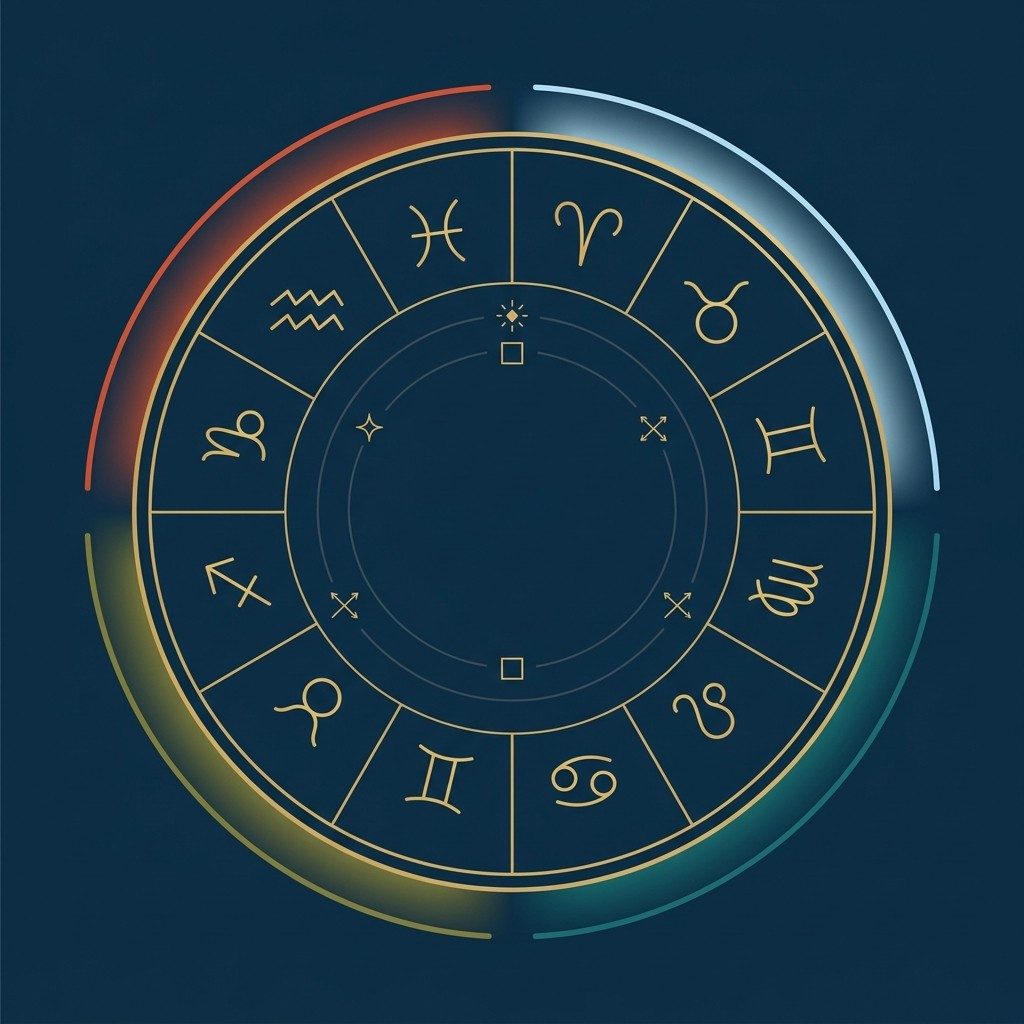
Most people learn the twelve signs as a list and try to hold all of it in memory. There is a shorter way in. Every sign is two labels stacked: one of four elements, and one of three modalities. Four times three is twelve, and the twelve combinations are the twelve signs, each used exactly once. Learn the two short lists and you can rebuild the whole zodiac on a napkin.
Two coordinates on the same wheel
The zodiac here is twelve equal slices of the ecliptic, each thirty degrees wide, counted from the March equinox. That geometry is fixed, and the calculators read positions against it, which the how we calculate page sets out in full. Element and modality do not change any of that arithmetic. They are names attached to the same twelve slices, and each name describes a different thing about a slice.
The element says what kind of thing a sign is made of, in the old vocabulary: fire, earth, air or water. The modality says where the sign sits in the turning of the season, and so how it tends to move. It opens, it holds, or it hands over. Put the two together and a sign stops being an abstract noun and becomes something closer to a description.
The four elements, three signs each
Fire signs are Aries, Leo and Sagittarius. Earth signs are Taurus, Virgo and Capricorn. Air signs are Gemini, Libra and Aquarius. Water signs are Cancer, Scorpio and Pisces.
Notice the spacing. Each element takes every fourth sign, so the three signs of an element sit at the points of a triangle around the wheel. Older texts call this a trine, and it is why Fire signs are said to understand each other on sight. The spacing is not a metaphor, just the same four step walk repeated three times.
The elements alternate in a fixed order: fire, earth, air, water, then fire again. No two signs of the same element sit side by side, so a Fire sign is always flanked by an Earth sign and a Water sign.
The three modalities, four signs each
Cardinal signs open: Aries, Cancer, Libra and Capricorn. Fixed signs hold: Taurus, Leo, Scorpio and Aquarius. Mutable signs close: Gemini, Virgo, Sagittarius and Pisces.
The pattern comes from the seasons. The cardinal signs begin at the two equinoxes and the two solstices, the four moments the year turns. The fixed signs sit in the middle of each season, when the weather has settled. The mutable signs sit at the end, in the last weeks before the next turn.
Four boundaries and three modalities means the modality changes by two places each step while the element changes by one. That offset is the trick that makes every combination appear once.
How the grid builds the twelve signs
Start at Aries with cardinal fire. Step forward one sign and the element advances one place, to earth, while the modality jumps two, to fixed. That gives fixed earth, which is Taurus. Step again and you get mutable air, which is Gemini. Step again and you get cardinal water, Cancer.
The cycle repeats three times
Continue and the same run plays out: fixed fire is Leo, mutable earth is Virgo, cardinal air is Libra, fixed water is Scorpio, mutable fire is Sagittarius, cardinal earth is Capricorn, fixed air is Aquarius, mutable water is Pisces. The next step returns to cardinal fire and the wheel closes.
The sign order is not arbitrary and not a memory test. It falls out of two short lists crossed with each other: say the elements in order and the modalities in order, and the twelve names regenerate in sequence.
Why no two signs share a pair
There are four elements and three modalities, and four times three is twelve. The walk around the wheel visits each pairing once before returning to the start, so no two signs hold the same element and modality together. That is why the pair works as a short label. Saying cardinal fire identifies Aries and nothing else.
It also explains why the signs divide neatly into fours and threes, and why talking about the fixed signs or the water signs names a real set rather than a mood.
Reading the grid on your own signs
The zodiac sign calculator returns your Sun, Moon and Rising signs together, and each one carries its own pair. A Leo Sun is fixed fire. A Cancer Moon is cardinal water. An Aquarius Rising is fixed air, though the rising sign needs a birth time and a city before it can be found at all.
What the pair adds, and what it does not
The pair is a label for the slice, not a second personality system layered on top of the first. Your Leo Sun is fixed fire whether or not you feel stubborn, because fixed and fire are simply the coordinates of that slice. What changes between your Sun, Moon and Rising is which point of the chart is being named, not the grid itself. The Moon sign calculator and the rising sign calculator each report the same two labels for a different point.
In practice the pairs are most useful as a memory aid and for comparing two placements quickly. Signs of the same modality share a season position, signs of the same element share the trine spacing, and one label is faster than counting around the wheel.
Where the grid stops being useful
The grid names positions. It does not forecast events, score a relationship, or describe a person in any testable way. The two labels describe the slice, not a destiny. The twelve signs index lists the usual date range for each one, and the calculators show where a birth date and time actually land.
Two limits are worth stating plainly. A full chart has around ten placements, and three do not add up to the whole picture. And the labels are a convention: useful because everyone uses the same one, not because the sky is divided that way by nature. The equinox is real. The name Aries is an agreement, and the grid keeps it consistent.
Check your own signs
To see the grid in action, run your birth date through the calculators and write the element and the modality beside each result. Three lines, six words, and the whole zodiac becomes a small table you can hold in your head.