Zodiac Signs vs Houses: What the Difference Is
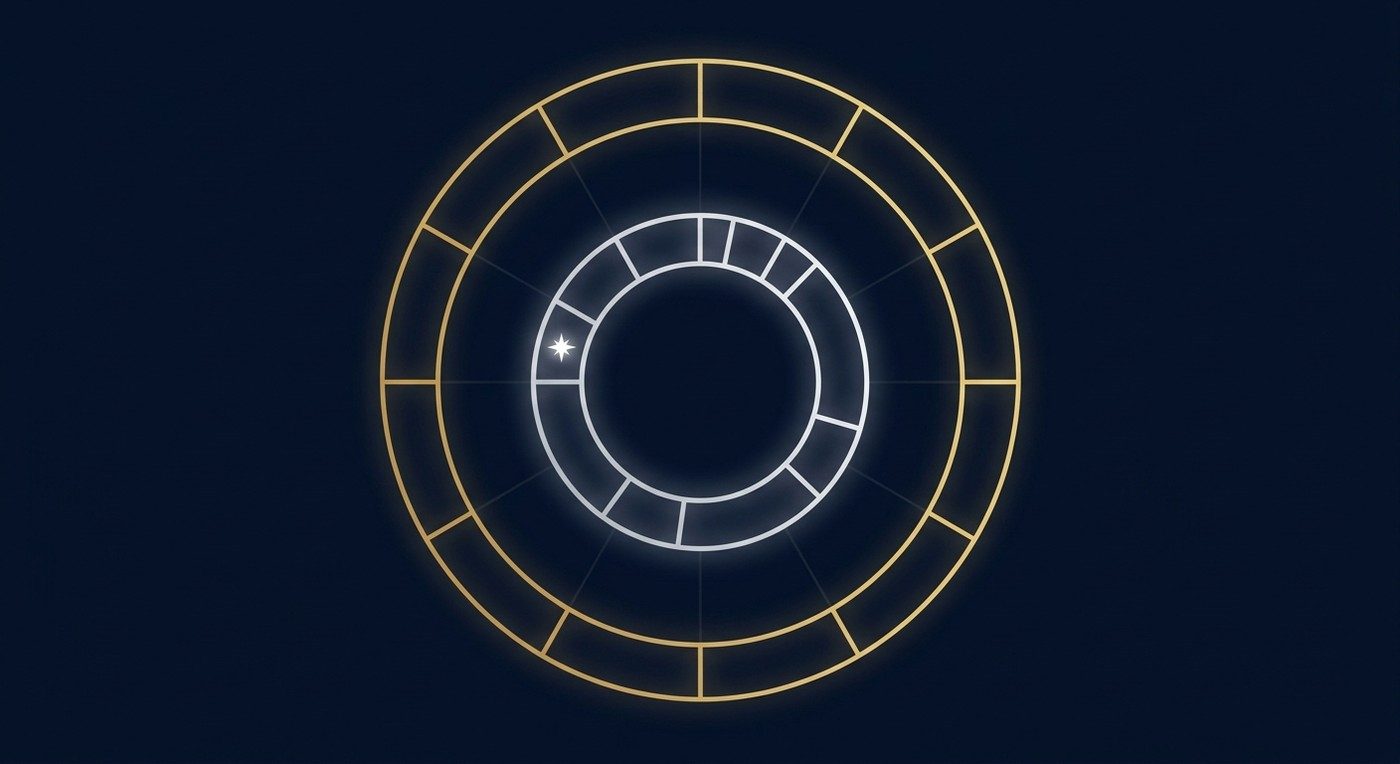
Most people who look up their sign stop at one answer: the sign the Sun was in on their birth date. That is real, but only half of how a chart is laid out. The other half is the house, and the two are easy to confuse because both number twelve.
A sign is a slice of sky, a house is a slice of time
Start with what each one measures. A sign is a 30 degree slice of the ecliptic, the path the Sun appears to trace across a year. The count starts at the March equinox, which is why Aries always opens the list. The signs are the same for everyone and hold steady for centuries at a time. The zodiac sign page lists all twelve with their date ranges.
A house is not a slice of sky at all. It is a slice of the day, measured from the place you were born. The sky turns a full circle in roughly 24 hours, so the eastern horizon sweeps through every sign, and a chart divides that turn into twelve sections. House one is the sky coming up over the horizon at your birth. House twelve is the sky still below it. Two babies born in the same city a few hours apart keep the same signs but sit in different houses.
Why there are twelve of each but they do not meet at the edges
With twelve signs and twelve houses it is tempting to assume sign one goes with house one. That only works for some people. The houses are cut by the turning sky, and the sky does not turn at a steady rate against the zodiac. Near the equator the sections come out close to equal. Farther from it, some houses cover a wide stretch of the ecliptic while others are squeezed into a sliver. A single house can begin halfway through a sign.
That is the difference in one line. Signs divide the sky evenly. Houses divide your day, and they do it unevenly.
Your first house starts at your rising sign
The boundary at the start of house one is the eastern horizon at your birth, and the sign sitting on that boundary is your rising sign. This is why the rising sign always needs a birth time and a city, while the Sun sign usually needs only the date. The rising sign calculator asks for both, because both move the answer.
Once the rising sign is known, the rest follows in order. If your rising sign is Virgo, house one is Virgo, house two is Libra, and the count carries on around the wheel. Which sign lands on each house boundary depends on where that first boundary fell.
Whole sign counting, the simple case
One older method, still used widely, skips the uneven division altogether. It makes house one the whole sign of your rising sign, house two the next whole sign, and so on. Under that method the two systems line up neatly, sign for sign.
Most modern calculators, including the ones on this site, work with degree positions rather than whole signs. The difference matters when a planet sits close to a boundary, since the two conventions can place it in different houses. Neither is wrong, and a sensible chart tool states which one it used. The how we calculate page sets out the approach this site takes.
What that means in practice
If a description of a placement does not match what you expected, check the convention first. A planet sitting a few degrees from a boundary is the usual reason.
What a house adds that a sign cannot
A sign describes how a planet expresses itself. A house describes where that expression shows up. The same planet in the same sign lands in a different area of life depending on its house.
Houses carry subjects. The first is your body and the way you arrive in a room. The second is money you earn. The fourth is home. The seventh is one-to-one partnerships. The tenth is work in public view. Signs carry manner instead, so Aries acts quickly and Taurus steadily.
Read together, the sentence becomes manner plus subject. Venus in Scorpio in the second house is not the same as Venus in Scorpio in the ninth. One is intensity applied to resources. The other is intensity applied to travel, study or belief.
Which tool answers which question
For a sign, the zodiac sign calculator returns the sign the Sun occupied on your date. That is a one step lookup and needs no clock.
For a house, you need a birth time and a place. Without those, the first house boundary is unknown, and with no boundary there is no house number to assign. A chart drawn without a birth time is a chart of signs only. It cannot tell you where house one falls.
If you have only a date, work with the signs. With a time from a birth certificate, the same data becomes a full layout. The moon sign calculator sits between the two, asking for a time only on the days the Moon changes sign.
Mix-ups worth knowing
The most common one is treating house numbers as sign numbers. Aries is the first sign, so house one must be Aries. That holds only when Aries is your rising sign, which happens for about one person in twelve.
The second is assuming a house is a fixed patch of sky like a constellation. It is not. A house is a section of a turning day, drawn for one place at one moment, which is why two people born at the same clock time in different cities can hold different houses.
The third is expecting the houses to come out equal. They often do not, and that is normal rather than a fault.
How to read your own chart in order
Write down your date, your time and your birth city before you open anything. Find the Sun sign from the date. Find the rising sign from the time and the city. Use the rising sign to place the houses. Keep the three answers on one line so you can see how they relate.
If your time is uncertain by an hour or more, the rising sign can move a whole sign and the houses shift with it. Treat the sign answers as firm and the house answers as a range.
Everything you type stays on your own device. The calculations run in the browser and no birth data is sent anywhere.