Why the Zodiac Starts at the March Equinox
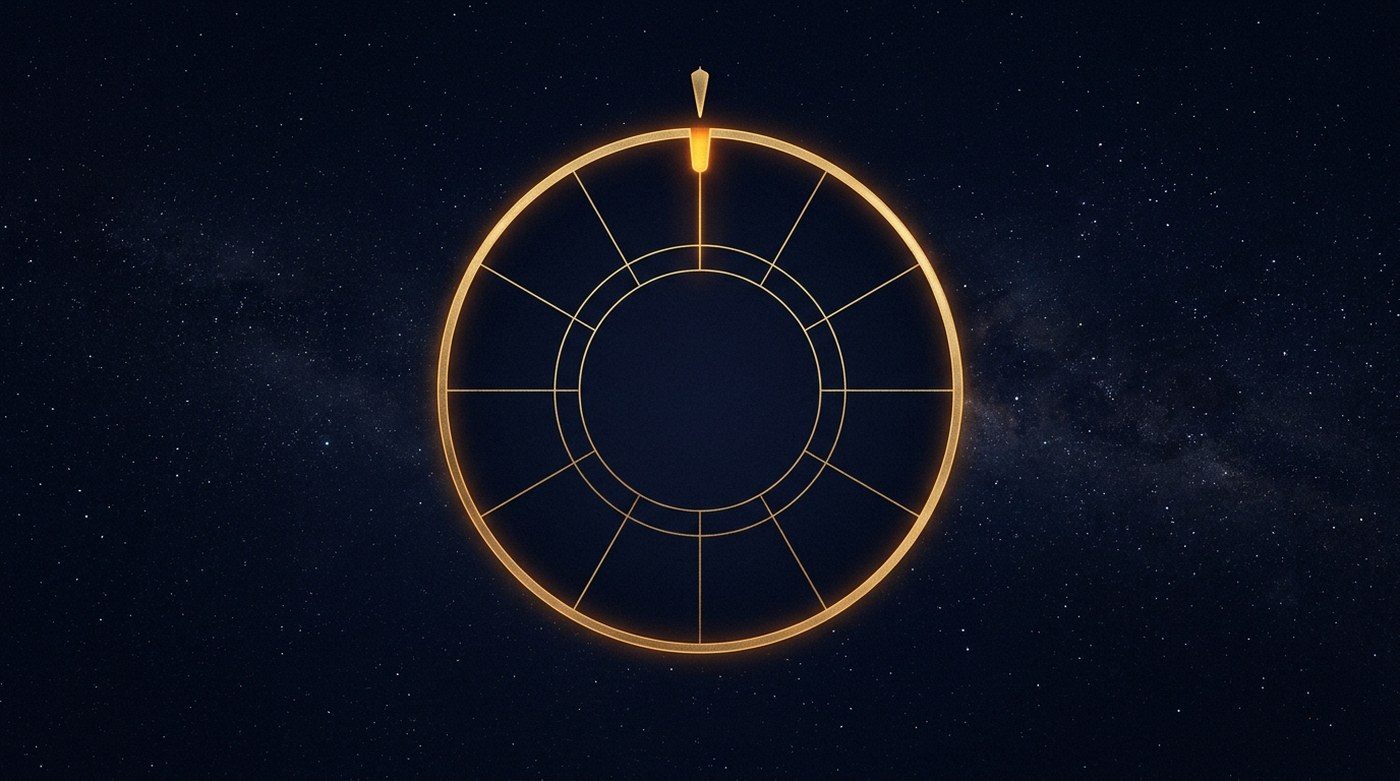
Every zodiac wheel has to begin somewhere. Most people never ask where, and the answer explains a lot of the confusion that follows: why the dates shift by a day, why the sign and the constellation behind it disagree, and why two astrologers using different systems can give the same birthday two different signs. The starting point is not a star. It is a moment in the year.
The zero point is a season, not a star
In the system CalcJournal uses, zero degrees of Aries is the March equinox. That is the instant in late March when the Sun crosses the celestial equator heading north, and day and night are close to equal everywhere on Earth. From that instant the wheel is counted forward in twelve equal slices of thirty degrees each, and the Sun enters each new slice about a month later.
This is why the sign boundaries land on almost the same calendar dates every year. They are tied to the seasons, not to the stars. Aries begins with spring in the northern hemisphere, Cancer with the June solstice, Libra with the September equinox, and Capricorn with the December solstice. The four cardinal signs sit on those four turning points, which is exactly what the word cardinal means.
What the March equinox actually marks
The equinox is a geometric event, not a visible one. The Earth's axis is tilted about 23.4 degrees from the plane of its orbit, and that tilt points the same way in space all year. Twice a year it is side-on to the Sun, so the Sun sits directly above the equator. In March it is moving north, in September south.
Astronomers call the March crossing the vernal equinox, and the point on the sky where it happens is the first point of Aries. That name is a leftover. The point no longer sits in the stars of Aries, and it has not for roughly two thousand years. It is still the zero mark, because the whole system was built to keep the seasons fixed and let the stars drift.
Why the wheel is counted from there
A calendar of the sky needs a reference that does not move. The stars do move, slowly, through a wobble in the Earth's axis called precession that takes about 25,800 years to complete one turn. If the zodiac were pinned to the stars, the sign boundaries would slide against the seasons by roughly one day every seventy years, and after a few centuries spring would begin in what the wheel still called Pisces.
Pinning the wheel to the equinox instead keeps the twelve signs aligned with the year. The trade-off is that the names no longer describe the star patterns behind them. That is the whole reason a sign and a constellation can disagree on the same date, and it is a design choice rather than an error.
The other starting point: the sidereal zodiac
Not every tradition counts from the equinox. The sidereal zodiac, used in much of Vedic astrology, counts from a fixed set of stars instead. Because the two starting points have drifted apart, they now differ by roughly 24 degrees, which is close to a whole sign. A person born in early April can be Aries in one system and Pisces in the other, and both answers are internally consistent.
Which one to use
Neither system is a mistake. They answer different questions. One asks where the Sun was relative to the seasons, the other asks where it was relative to the stars. Mixing the two without saying which one you are using is where readings go wrong.
Why the dates drift by a day
If the wheel is fixed to the equinox, why does the Sun not enter Aries on the same date every year? Because the calendar and the orbit do not divide evenly. A year is about 365.24 days, so the equinox arrives roughly six hours later each year until a leap day pulls it back. The Sun also moves slightly faster near January and slower near July, since the orbit is an ellipse rather than a circle.
The result is a boundary that wanders by a day or so across a four year cycle. That is why a birthday on the first or last day of a sign cannot be settled from the date alone. The year matters, and so does the clock time on that day.
What this means for the rising sign
The same zero point anchors the rising sign, but the measurement is different. The rising sign is the slice coming over the eastern horizon at your birth, and it turns a full circle in about 24 hours. Because the slices are not all the same width in time, some signs rise in under an hour and others take more than two. That is why the rising sign needs a birth time and a city, while the Sun sign usually needs only a date.
The Moon sign sits between the two in difficulty. The Moon crosses a slice in about two and a half days, so a birth date is usually enough, but a birth on a changeover day needs the hour.
How the calculator handles it
The zodiac sign calculator counts the twelve slices from the March equinox and reports the Sun's position in that frame. It also reports the constellation behind the Sun as a separate line, so the two maps are never blended into one answer. The how we calculate page names the library used for the positions and the accuracy it claims.
Nothing you type leaves your device. The date, the city and the time are used to compute a result in the browser, and they are not sent to a server or stored.
Checking your own sign
If your birthday is comfortably inside a sign, the date is enough and the answer will not move. If it sits on an edge, put the year and the hour into the calculator and let it decide. The zodiac sign index lists the usual date ranges for all twelve, and each sign page shows the nearby birthdays that fall on the boundary.
Once you know the Sun sign, the moon sign calculator and the rising sign calculator add the two placements that need more than a date. Together they answer three different questions, and none of them is a forecast. They are positions on a wheel that starts, every year, at the same quiet moment in March.